

Scraping Data for AI Training: A Quality-First Python Pipeline
Build a permission-first Python text dataset: extract clean HTML, retain provenance, filter duplicates, and test when residential proxies are useful.
 Ludax Proxy TeamAuthor
Quick answer: Scraping data for AI training is not just downloading web pages. Start with sources you are entitled to use, check access rules, extract the main text, remove low-quality or duplicate documents, review privacy risks, and save each accepted document with its URL, capture time, language, and rights reference. Use a residential proxy only when an approved source needs location-specific access or a distributed collection path; the proxy does not grant permission to train on that content.
A dataset with 100,000 random HTML pages can be less useful than 2,000 reviewed documents that match your task. Navigation menus, cookie banners, machine-generated copies, outdated policies, and error pages can all become misleading training material if they pass through your scraper unchecked.
This tutorial builds a small, auditable text-collection pilot in Python. It creates one JSONL record per accepted document. The same principles apply to language-model fine-tuning corpora, retrieval-augmented generation (RAG) sources, and evaluation sets—but those three uses require different downstream handling.
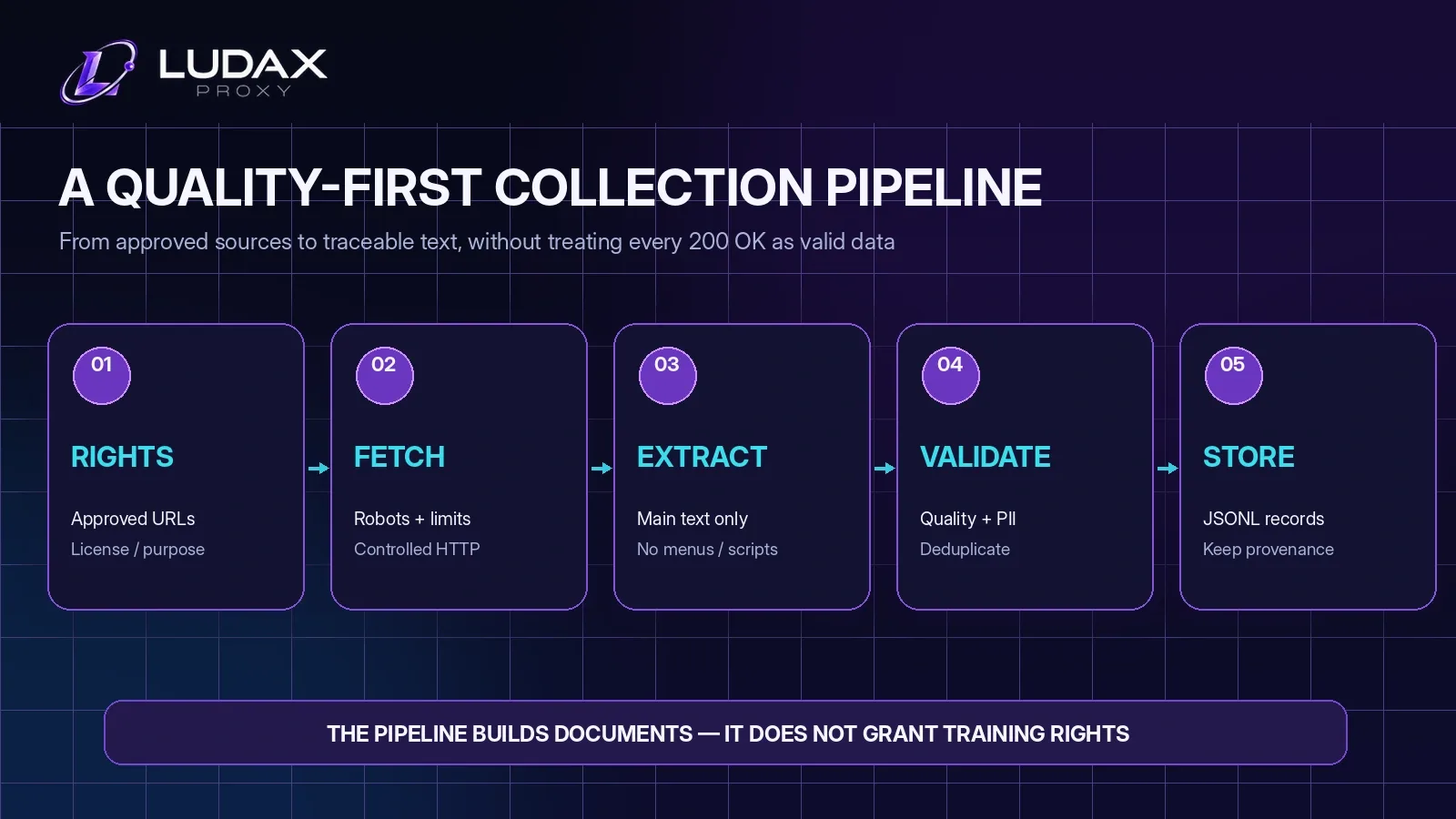
What you will build: approved URL manifest → policy check → controlled fetch → clean text → quality gate → exact deduplication → JSONL with provenance. You will also learn when Ludax Proxy Residential Proxies belong in that sequence and when a direct connection is sufficient.
Scope and responsibility: The sample uses a deliberately small, reviewed source list. Do not use it to access private data, circumvent restrictions, ignore rate limits, or assume that publicly accessible text is licensed for AI training. Review source contracts, copyright, privacy requirements, and applicable laws before any live collection.
Jump to: Intent and dataset choice · Permission and source manifest · Python tutorial · Quality checks · Residential proxies · FAQ
First decide what your AI dataset is for
The phrase AI training data is broad. Before scraping a page, define the job the text must do. That decision changes how you select sources, split documents, and evaluate quality.
Dataset purpose | Typical input | What matters most | Where the pipeline stops |
|---|---|---|---|
Model pretraining | Large, diverse, rights-cleared text corpora | Language coverage, provenance, duplication control, licensing | Curated corpus ready for training-specific preprocessing |
Fine-tuning / instruction data | Reviewed examples, prompts, answers, task demonstrations | Task relevance, consistent labels, rights, sensitive-data review | Supervised examples, not raw pages alone |
RAG knowledge base | Current docs, articles, manuals, approved support material | Freshness, source URLs, chunk quality, citation traceability | Clean documents to chunk and index |
Evaluation / benchmark | Held-out, representative documents and tests | No leakage from training, stable versions, human verification | Frozen evaluation set with clear origin |
For example, a support chatbot usually needs RAG from owned documentation, not millions of crawled pages. A multilingual language-model experiment might require a much broader corpus, with rights and language balance reviewed in advance. A vendor's proxy service should never be mistaken for a source-licensing service.
Do you actually need to scrape?
Check cheaper and safer sources first: a publisher API, a licensed export, a dataset provided for the intended use, or your own documentation repository. Common Crawl is also a useful existing web-crawl source to investigate, but its own terms note that underlying crawled content may carry separate rights and restrictions. "Available in an archive" is not the same as "cleared for every training purpose."
Only scrape when your approved data is genuinely missing from those sources, freshness or localization matters, and you can explain why the collection is necessary. This decision prevents avoidable storage, network traffic, and rights-review work.
Make a source manifest before writing a crawler
Treat the manifest as the collection contract. Each URL must have a documented permission basis and a business purpose. A URL appearing in search results is not a sufficient permission record.
Field | Example | Why it belongs in every batch |
|---|---|---|
|
| Identifies the exact requested page |
|
| Links documents to the same approved source |
|
| Describes why the content may be collected |
|
| Points reviewers to permission evidence |
|
| Labels the requested geographic view, if applicable |
|
| Allows later language QA and sampling |
Use rights_basis values such as owned, licensed, or written_permission only after verifying them. The pilot script checks that a record exists, not whether your legal conclusion is correct. Keep the supporting evidence somewhere outside the public article and outside the crawl output.
Robots rules, terms and privacy are different checks
The Robots Exclusion Protocol (RFC 9309) defines crawling preferences; it explicitly does not grant authorization. Before a collection, evaluate robots rules and source terms and the legal basis for subsequent reuse of content. Permission to read a page may differ from permission to train on it.
Personal data requires a separate review, even when it is visible on a public page. The European Data Protection Board's 2026 guidance on scraping for generative AI and the UK ICO's analysis explain why purpose, legal basis and safeguards matter. A simple email regex is only a first alarm, not a complete privacy system.
Python tutorial: HTML to auditable JSONL
This example is deliberately bounded. It does not discover sites, follow redirects, scrape logged-in pages, or retry through blocked endpoints. It reads a small allowlisted manifest and saves only reviewed, useful HTML text. This makes the first run easier to audit and less likely to poison your dataset.
Step 1: Install two dependencies
From a local terminal in a clean Python environment:
python -m pip install requests beautifulsoup4Download the companion Python file from this article's package. First run the offline demo. It uses a synthetic HTML document, makes no network requests, and proves that extraction, validation and JSONL writing work:
python LudaxProxy_AI_Text_Dataset_Pipeline.py --demoExpected kind of output (fixture only, not a benchmark):
Demo OK: 113 words, JSONL written to ai_text_corpus.jsonlOpen the resulting .jsonl file. Each line is one JSON object containing the text and its source metadata. The demo uses an example URL as a label; it does not fetch that website.
Step 2: Add approved URLs, not random search results
Create a UTF-8 file named approved_sources.csv. Replace the demonstration hostname and rights reference with your own verified source:
url,source_id,rights_basis,rights_reference,market,language
https://your-approved-domain.example/guide/1,company_docs,owned,internal-policy-2026-04,de,en
For a live pilot, start with five to ten documents from one source. Check the publisher's policy, then run:
python LudaxProxy_AI_Text_Dataset_Pipeline.py --manifest approved_sources.csv --output ai_text_corpus.jsonlThe script limits each run to 20 URLs, checks robots.txt, uses a small delay, refuses unreviewed source declarations, and caps the downloaded body size. It does not follow redirects. A redirect target must be approved as a new manifest entry.
Step 3: Understand the exact pipeline code
The complete standalone script is reproduced here so developers can adapt and review it. In real deployments, use a supported robots parser, centralized scheduling, stronger PII review, and a durable job queue after the pilot proves its value.
"""Small, permission-first HTML-to-JSONL text corpus pilot.

Install: pip install requests beautifulsoup4
Try without network: python LudaxProxy_AI_Text_Dataset_Pipeline.py --demo
Run an approved manifest: python LudaxProxy_AI_Text_Dataset_Pipeline.py --manifest approved_sources.csv

This is a bounded pilot, not a production-scale crawler or a legal clearance tool.
"""

import argparse
import csv
import hashlib
import json
import re
import time
from datetime import datetime, timezone
from pathlib import Path
from urllib.parse import quote, urlsplit
from urllib.robotparser import RobotFileParser

import requests
from bs4 import BeautifulSoup

# Use ONLY your own approved URLs. Do not commit live proxy credentials.
# Generate credentials in the Ludax Proxy dashboard, then configure locally.
PROXY_USERNAME = ""  # e.g. resi-YOUR_ACCOUNT
PROXY_PLAN_PASSWORD = ""  # e.g. YOUR_PLAN_PASSWORD
PROXY_GATEWAY = "gw.ludaxproxy.com:7777"  # standard Residential HTTP(S)
USER_AGENT = "DatasetResearchBot/1.0 (+https://your-company.example/bot)"
MIN_WORDS = 70
MAX_URLS = 20
MAX_BODY_BYTES = 1_500_000
MIN_GAP_SECONDS = 2.0
EMAIL_RE = re.compile(r"[\w.+-]+@[\w.-]+\.[A-Za-z]{2,}")
BLOCK_PAGE_TERMS = ("enable javascript to continue", "verify you are human", "captcha required")
ALLOWED_RIGHTS = {"owned", "licensed", "written_permission"}


def proxy_url(market):
    if not (PROXY_USERNAME and PROXY_PLAN_PASSWORD):
        return None  # no proxy: useful baseline for owned sources
    suffix = "-country-" + market.lower() if market else ""
    user = quote(PROXY_USERNAME, safe="")
    password = quote(PROXY_PLAN_PASSWORD + suffix, safe="")
    return f"http://{user}:{password}@{PROXY_GATEWAY}"


def get_session(market):
    session = requests.Session()
    session.trust_env = False  # prevent unexpected environment proxy overrides
    session.headers.update({"User-Agent": USER_AGENT, "Accept": "text/html"})
    p = proxy_url(market)
    if p:
        session.proxies = {"http": p, "https": p}
    return session


def checked_get(session, url):
    # No redirects; they must be added and reviewed as separate source URLs.
    with session.get(url, timeout=(10, 25), allow_redirects=False, stream=True) as response:
        code = response.status_code
        content_type = response.headers.get("Content-Type", "").lower()
        if code != 200:
            return code, content_type, b""
        chunks, size = [], 0
        for chunk in response.iter_content(chunk_size=32768):
            size += len(chunk)
            if size > MAX_BODY_BYTES:
                raise ValueError("Body exceeded size cap; skip")
            chunks.append(chunk)
        return code, content_type, b"".join(chunks)


def robots_allowed(session, url):
    parsed = urlsplit(url)
    robots_url = f"{parsed.scheme}://{parsed.netloc}/robots.txt"
    code, content_type, payload = checked_get(session, robots_url)
    if code in (404, 410):
        return True  # no rules published; source permission is checked separately
    if code != 200 or len(payload) > 300_000:
        return False  # fail closed on server errors or uncertain policy
    robots = RobotFileParser()
    robots.parse(payload.decode("utf-8", "replace").splitlines())
    return bool(robots.can_fetch(USER_AGENT, url))


def clean_html(html):
    soup = BeautifulSoup(html, "html.parser")
    for node in soup.select("script,style,noscript,nav,header,footer,aside,form,button"):
        node.decompose()
    body = soup.select_one("article") or soup.select_one("main") or soup.body
    if not body:
        return ""
    # Keep paragraph and heading boundaries for a readable, auditable record.
    text = body.get_text("\n", strip=True)
    lines = [re.sub(r"\s+", " ", line).strip() for line in text.splitlines()]
    return "\n".join(line for line in lines if line)


def accept_document(html):
    text = clean_html(html)
    normalized = re.sub(r"\s+", " ", text).strip()
    if len(normalized.split()) < MIN_WORDS:
        return None, "too_short"
    if any(phrase in normalized.lower() for phrase in BLOCK_PAGE_TERMS):
        return None, "challenge_page"
    if EMAIL_RE.search(normalized):
        return None, "possible_personal_data_review"
    # A basic example gate; production requires stronger PII checks and review.
    return text, "accepted"


def make_record(source, text, status):
    normalized = re.sub(r"\s+", " ", text).strip()
    digest = hashlib.sha256(normalized.encode("utf-8")).hexdigest()
    return {
        "document_id": digest[:24],
        "source_url": source["url"],
        "source_id": source["source_id"],
        "rights_basis": source["rights_basis"],
        "rights_reference": source["rights_reference"],
        "market": source.get("market", ""),
        "language": source.get("language", ""),
        "fetched_at_utc": datetime.now(timezone.utc).isoformat(),
        "status_code": status,
        "sha256": digest,
        "word_count": len(normalized.split()),
        "text": text,
    }


def validate_source(source):
    url = source.get("url", "")
    parsed = urlsplit(url)
    if parsed.scheme != "https" or not parsed.hostname or parsed.username or parsed.password:
        raise ValueError("Only approved public HTTPS URLs without URL credentials are supported")
    if source.get("rights_basis", "").lower() not in ALLOWED_RIGHTS:
        raise ValueError("rights_basis must be owned, licensed or written_permission")
    if not source.get("rights_reference", "").strip():
        raise ValueError("rights_reference must identify a reviewed permission or license")
    if not source.get("source_id", "").strip():
        raise ValueError("source_id is required")
    return source


def run_sources(sources, output_path):
    if len(sources) > MAX_URLS:
        raise ValueError(f"Pilot limit is {MAX_URLS} URLs per run")
    seen, last_request = set(), {}
    output_path.parent.mkdir(parents=True, exist_ok=True)
    with output_path.open("w", encoding="utf-8") as out:
        for source in sources:
            validate_source(source)
            url = source["url"]
            market = source.get("market", "")
            hostname = urlsplit(url).netloc
            elapsed = time.monotonic() - last_request.get(hostname, 0)
            if elapsed < MIN_GAP_SECONDS:
                time.sleep(MIN_GAP_SECONDS - elapsed)
            with get_session(market) as session:
                try:
                    if not robots_allowed(session, url):
                        print(f"SKIP robots/policy unavailable: {hostname}")
                        continue
                    status, content_type, payload = checked_get(session, url)
                    last_request[hostname] = time.monotonic()
                    if status != 200 or "text/html" not in content_type:
                        print(f"SKIP non-HTML/status {status}: {hostname}")
                        continue
                    text, reason = accept_document(payload)
                    if text is None:
                        print(f"SKIP {reason}: {hostname}")
                        continue
                    record = make_record(source, text, status)
                    if record["sha256"] in seen:
                        print(f"SKIP exact duplicate: {hostname}")
                        continue
                    seen.add(record["sha256"])
                    out.write(json.dumps(record, ensure_ascii=False) + "\n")
                    print(f"KEEP {record['word_count']} words: {hostname}")
                except (requests.RequestException, ValueError) as error:
                    # Do not print full proxy URL, credentials or full response bodies.
                    print(f"SKIP request/problem: {hostname} ({type(error).__name__})")
    print(f"Saved {len(seen)} accepted documents to {output_path}")


def demo(output_path):
    # Offline fixture: not scraped content and not evidence of provider performance.
    sample = " ".join([
        "A quality-first language dataset begins with a documented source and a clear use case.",
        "The team checks whether collection is permitted and records the scope of permission.",
        "Each HTML page is parsed into readable text with navigation and scripts removed.",
        "A good record stores the page URL, capture time, language, and rights reference.",
        "The pipeline rejects empty pages and exact copies before creating a corpus.",
        "Researchers examine unusual records manually because automatic filters make mistakes.",
        "Keeping training and evaluation sources separate reduces the risk of leakage.",
        "Refresh jobs can update stale documents while preserving their earlier provenance.",
        "Before large runs, a small pilot checks useful pages, failures and traffic cost.",
    ])
    html = f"<html><body><header>Navigation</header><article><h1>Approved data pilot</h1><p>{sample}</p></article></body></html>"
    text, reason = accept_document(html)
    assert text is not None, reason
    source = {"url": "https://example.org/approved-demo", "source_id": "demo", "rights_basis": "owned", "rights_reference": "offline-fixture", "market": "", "language": "en"}
    record = make_record(source, text, 200)
    output_path.write_text(json.dumps(record, ensure_ascii=False) + "\n", encoding="utf-8")
    print(f"Demo OK: {record['word_count']} words, JSONL written to {output_path}")


def main():
    parser = argparse.ArgumentParser()
    parser.add_argument("--demo", action="store_true", help="Use an offline synthetic fixture")
    parser.add_argument("--manifest", help="CSV columns: url,source_id,rights_basis,rights_reference,market,language")
    parser.add_argument("--output", default="ai_text_corpus.jsonl")
    args = parser.parse_args()
    output_path = Path(args.output)
    if args.demo:
        demo(output_path)
    elif args.manifest:
        with open(args.manifest, newline="", encoding="utf-8") as manifest:
            run_sources(list(csv.DictReader(manifest)), output_path)
    else:
        parser.error("Use --demo or --manifest; no unsolicited crawl is enabled")


if __name__ == "__main__":
    main()
Step 4: Read the output and check what was rejected
A real accepted JSONL record has fields like these (the values below illustrate the schema, not a real scrape):
{
  "document_id": "<content-hash-prefix>",
  "source_url": "https://your-approved-domain.example/guide/1",
  "source_id": "company_docs",
  "rights_basis": "owned",
  "rights_reference": "internal-policy-2026-04",
  "market": "de",
  "language": "en",
  "fetched_at_utc": "<ISO-8601 timestamp>",
  "status_code": 200,
  "sha256": "<full-content-sha256>",
  "word_count": 450,
  "text": "<extracted document text>"
}
The console distinguishes accepted documents from short pages, possible PII, challenge pages, status errors, and exact duplicates. Treat the "possible personal data" case as a review task, not a file to silently include. The regex deliberately errs on the side of skipping obvious email addresses and misses other kinds of personal data.
What this pilot does not do: near-duplicate detection, comprehensive copyright or PII clearance, language detection, cross-run deduplication, retries, JavaScript rendering, large-corpus scheduling, tokenization or dataset splitting. Do not advertise its JSONL output as "training-ready" until the next quality gates pass.
Quality checks when scraping data for AI training
An HTML fetch can return a valid 200 OK and still be useless. Consider a page that contains only a subscription modal, a cookie overlay, or a generic template. The HTTP status tells you transport succeeded; it does not certify the extracted text.
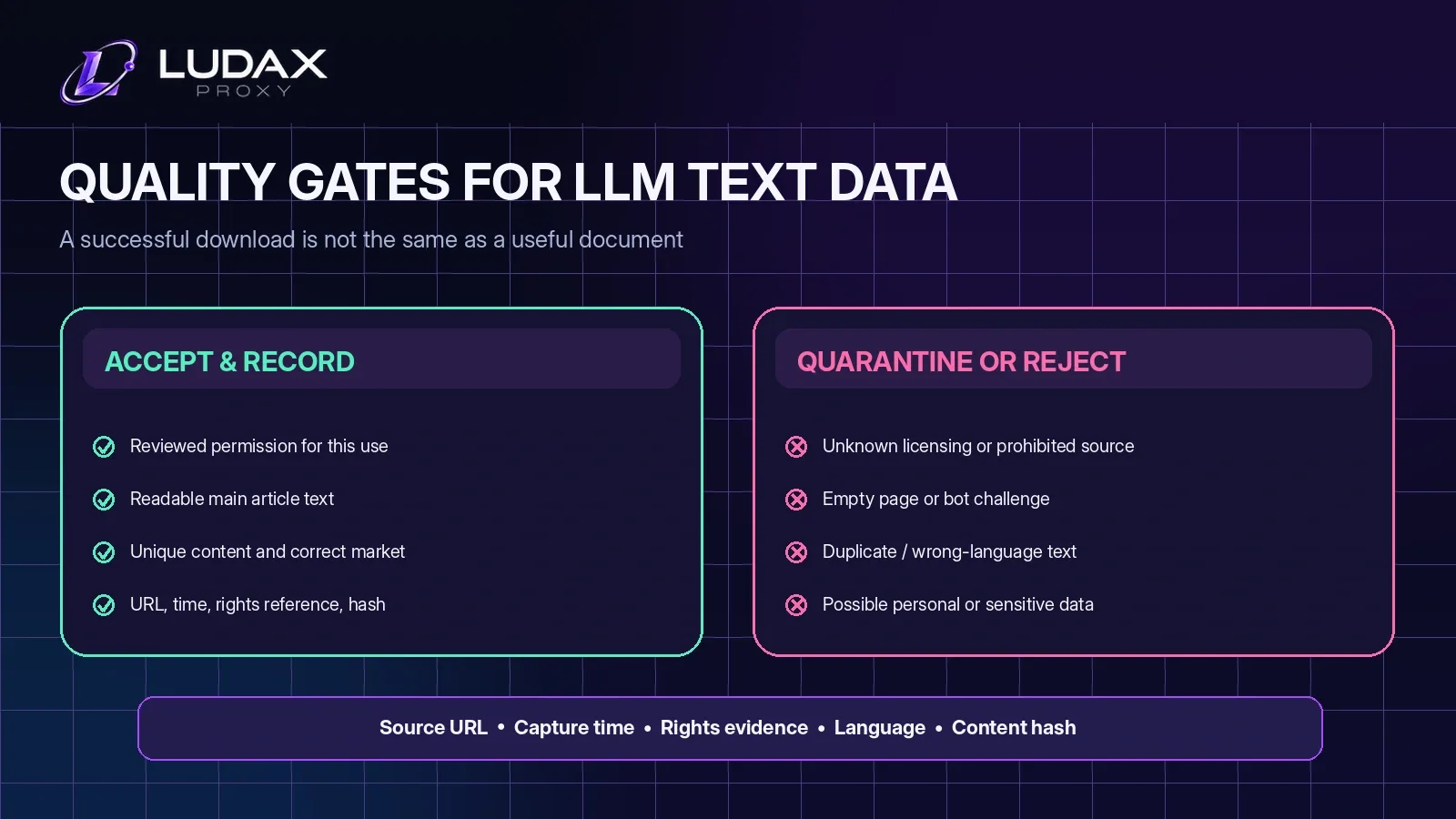
Five quality gates worth adding after the pilot
Gate | Practical test | Failure action |
|---|---|---|
Permission | Manifest has a reviewed source-rights record for the intended use | Do not collect or use it |
Content | Main text passes minimum length and human spot checks | Quarantine empty or template-only pages |
Duplicates | Exact hash first; near-duplicate similarity later | Keep a canonical copy and record duplicates |
Privacy | Automated detection plus human policy review for sensitive sources | Quarantine and investigate; do not silently upload |
Task fit | Language, freshness, domain and topic match corpus goals | Exclude or route to a separate dataset |
For multilingual corpora, record the observed language in addition to the requested market. A German exit IP does not guarantee a German-language page. For RAG, store document titles and update timestamps so your search index can replace stale pages. For fine-tuning, raw paragraphs usually need annotation or instruction formatting before training.
Prevent training and evaluation leakage
Split the source families, not just individual URLs, when near-duplicate documents might appear in both training and evaluation. Otherwise the evaluation set may contain reformatted copies of training text, making model performance look better than it is. Freeze evaluation records, their hashes, and their source manifest version. This is especially important for public documentation replicated across mirrors.
When residential proxies help AI text collection
A proxy changes the network route used to obtain a permitted response. It does not supply a dataset, a license, an extractor, or a trained model. The Ludax Proxy AI & Data Pipelines use-case page covers product fit and network capabilities; this tutorial concentrates on the dataset quality workflow that follows a response.
Situation | Recommended first approach | Is Residential useful? |
|---|---|---|
Downloading owned docs from one region | Direct access or official export | Usually unnecessary |
Licensed API with sufficient quota | API, preserving publisher terms | Usually unnecessary |
Approved pages whose content differs by country | Compare direct access with geo-targeted residential routes | Often useful for coverage testing |
Authorized recurring checks from several regions | Source-aware scheduler and regional exits | Can be useful, if allowed by the source |
A source blocks automation or forbids collection | Stop and seek permission or another source | Not a reason to bypass restrictions |
How to configure a Ludax Proxy pilot
For the standard Residential Proxies product, the documented HTTP(S) gateway is gw.ludaxproxy.com:7777. The Python example can connect through it by filling in two local configuration values, leaving the rest of the crawl logic unchanged:
PROXY_USERNAME = "resi-YOUR_ACCOUNT"
PROXY_PLAN_PASSWORD = "YOUR_PLAN_PASSWORD"
# The code appends -country-de when the manifest market is de.
Use credentials generated in your dashboard; never commit real values to source control. The sample URL list must already be approved for the intended location and purpose. If you need a different geography, adjust the manifest's market column and compare the content, not just the observed IP. For complete setup syntax, see the Ludax Proxy Python integration guide and authentication reference.
There is also a practical measurement point: a market label records the requested country, but an observed response may differ, or exit availability may vary. Store the actual observed location only if you separately verify it. Do not claim a requested region was delivered merely because it appeared in your password parameters.
Test a small regional source set before scaling
If you have written permission to collect location-dependent public pages, try Ludax Proxy Residential Proxies with a small plan. Compare a direct pilot against one approved regional pilot. Keep the rights review, URL list, content validator, and output schema identical so the network-path difference is measurable.
Evaluate approved sources across markets with residential exits, then measure valid documents and bandwidth before scaling.
Measure useful documents, not just fetched pages
A rate of 95% successful HTTP responses might still produce a poor corpus if half the results are cookie overlays or duplicates. For an AI data collection pilot, define success at the document level:
accepted-document rate = accepted unique documents / attempted approved URLs
usable text per GB = reviewed accepted text bytes / proxy bandwidth billed
The first metric captures data quality. The second helps evaluate collection efficiency, but text-byte count is not provider-billed network traffic. Use the dashboard's actual usage when measuring cost.
A controlled comparison table
Run the same approved sample and record the results yourself. The blank cells are intentional; no performance or completion statistics are invented.
Measure | Direct / official feed | Residential, market A | Residential, market B |
|---|---|---|---|
Approved URLs attempted | Fill after test | Fill after test | Fill after test |
Valid content documents | — | — | — |
Exact duplicates | — | — | — |
PII-review rejects | — | — | — |
Missing or unexpected locale | — | — | — |
Billed traffic (GB) | N/A or measured separately | Dashboard value | Dashboard value |
Accepted documents per GB | — | — | — |
Document your test date, sample list, worker location, requested market, and validation rules. Don't compare a 10-page German test with a 10,000-page global run and attribute the differences to the proxies.
If you need a detailed financial model, use the separate Proxy Bandwidth Cost per Scraped Record tutorial. Keeping cost formulas there prevents this guide from competing with a dedicated cost-analysis article.
Scale the pipeline without damaging the corpus
Once the pilot produces high-quality documents, add scheduling and recovery by source, not by the size of the available IP pool. Give each host its own concurrency cap. Honor explicit crawl windows, rate limits, and Retry-After; stop on denied access instead of treating proxy rotation as permission.
Rotation is a session choice, not a rights workaround
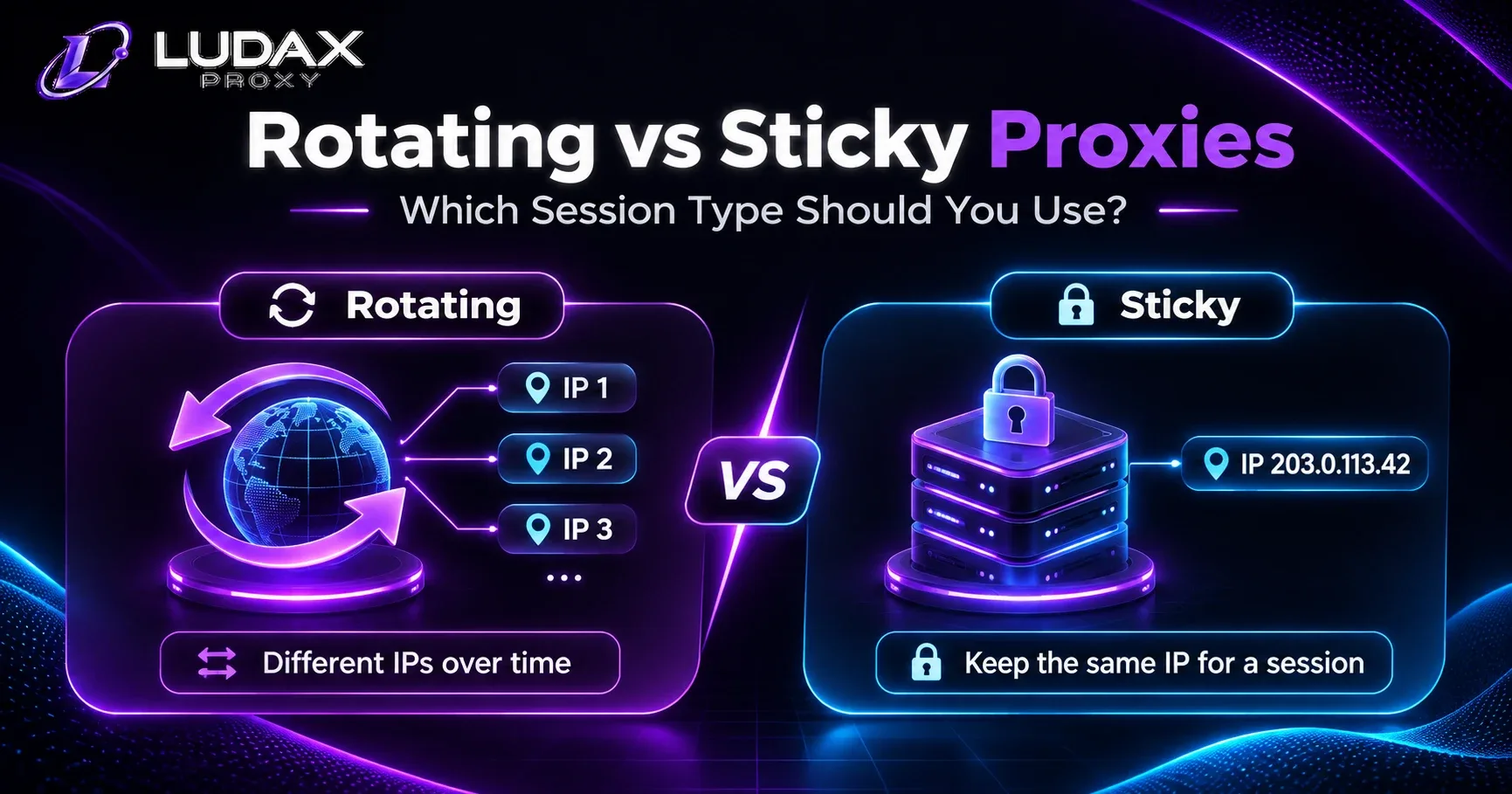
Independent approved documents may use separate connections, while a permitted multi-page workflow may benefit from a sticky session. The difference is explained in Rotating vs Sticky Proxies. In a scraping corpus, session behavior is secondary to permission, content validity, and provenance.
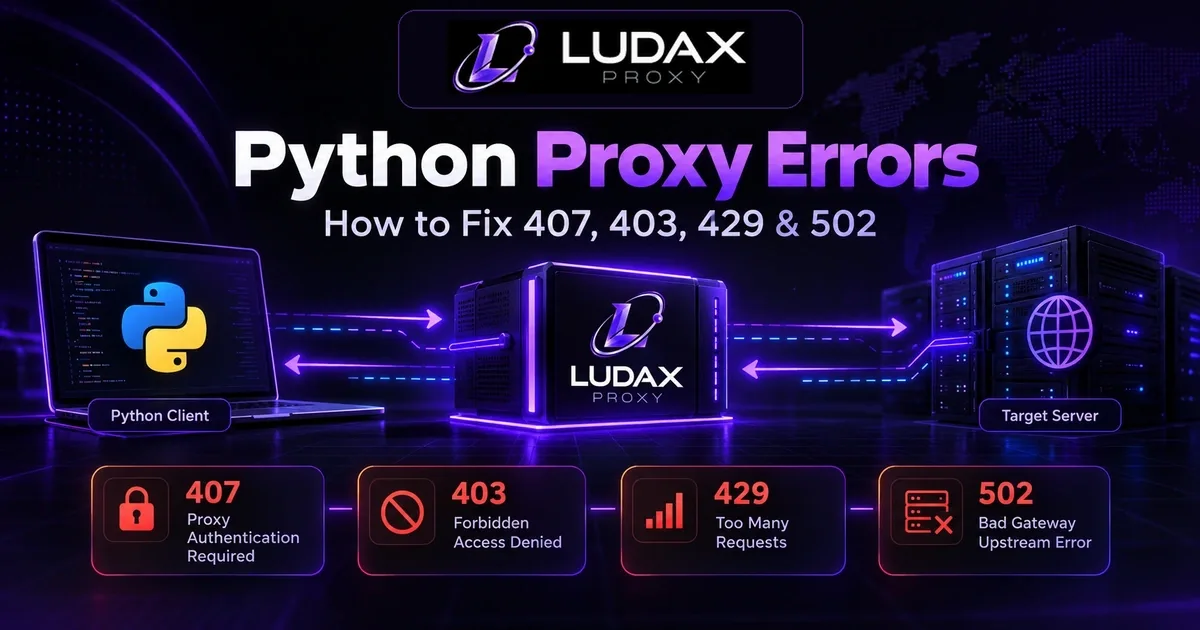
For 407, fix credentials and plan status rather than retrying repeatedly. For 429, pause and follow the publisher's limits. For 403, do not rotate to circumvent a restriction. The dedicated Python Proxy Errors guide explains how to classify technical failures before altering your job scheduler.
Preserve provenance across refreshes and deletions
Assign each source a stable ID and save the original URL, crawl timestamp, content hash, and rights reference. When a publisher changes permissions, requests removal, or updates a page, you need to find all derivative records: raw captures, cleaned text, chunks, embeddings, and any datasets made from them. A provenance record is what makes that review possible.
Keep source revision and corpus version separate. A new response with a different hash may be a useful update; it may also be a template change that should not enter the training set. Sample both before treating refreshes as an automatic improvement.
A production readiness checklist for AI data scraping
Before moving beyond the example, confirm that every participating source passes these conditions:
The source is explicitly approved for this use, not merely publicly reachable.
Robots rules and publisher rate limits have been reviewed and are respected.
The system records source URL, time, language, rights reference, and content hash.
Non-HTML, redirect, error, challenge, and obviously empty pages are rejected.
Near-duplicate and sensitive-data review are added before training or indexing.
Training, evaluation, and retrieval datasets are kept separable.
A source-removal or permission-change workflow is documented.
Bandwidth and accepted-document rate are measured on a real pilot.
Any geographic proxy use is justified by approved regional-content requirements.
Bottom line: collect fewer, better documents first. Then improve the coverage of sources you are permitted to use. A reliable text corpus is primarily an editorial, legal and engineering achievement; a residential network is one optional part of the transport layer.
AI training data scraping FAQ
Can I scrape public websites to train an LLM?
Not automatically. Public accessibility does not establish permission for a specific training use. Check the publisher's terms, copyright, privacy obligations, applicable exceptions, and any required permissions. Respect robots rules as well, but do not treat them as a license.
Are residential proxies necessary for LLM training datasets?
No. Licensed files, owned documents, approved APIs, and existing datasets may work without proxies. Residential proxies can help when a permitted collection needs to view location-dependent pages from different markets. They do not replace rights clearance or text validation.
What format should I save scraped text in?
JSONL is useful for a first corpus: one JSON object per line with text, source URL, collection time, rights reference, language, and hash. For RAG, you may later split documents into citation-preserving chunks. For fine-tuning, you usually need curated, task-specific examples rather than raw web text alone.
How do I prevent duplicates in AI scraping?
Start with normalized-text hashes to remove exact duplicates. Then add near-duplicate detection across templates, mirrored pages, and minor text revisions. Keep a canonical source record so duplicates do not leak into training and evaluation sets.
Is scraping data for AI training the same as building RAG?
No. Training changes model parameters; RAG retrieves external documents at query time. The collection and cleaning stages may overlap, but RAG prioritizes up-to-date source documents and citations while training pipelines need dataset-specific formatting and splits.
How do I know whether a proxy improved my AI dataset?
Compare the same approved source sample with a direct or official-feed baseline. Measure valid unique documents, correct regional content, review rejects and billed bandwidth. More successful requests do not automatically mean better training material.
Next step: validate the data pipeline before scaling
If the offline demo works, move to a handful of your own or properly licensed pages, review each JSONL output, and record why every accepted document is usable. Only then test a different network location where it adds legitimate coverage. For architecture and product-selection questions, visit the AI & Data Pipelines use case; for connection parameters, use the Python documentation.
Ready to test approved regional data collection?
Ludax Proxy Residential Proxies can provide the network path for a small, permission-based collection pilot. They do not host AI models or data corpora, and they do not determine whether third-party text can be used for training. Start with a controlled sample, verify the content and rights, and expand only when you have useful results.
Test location-aware residential access with transparent usage and session controls. Verify clean documents before increasing volume.
Frequently asked questions
1. Can I scrape websites to collect AI training data?
Publicly accessible content is not automatically licensed for AI training. Before scraping, review the website's terms, copyright restrictions, privacy requirements, and robots.txt rules. Prioritize owned content, licensed datasets, and sources with explicit permission.
2. Do I need residential proxies to scrape data for AI training?
Not always. Direct connections, official APIs, and licensed datasets may be sufficient. Residential proxies become useful when authorized data collection requires access to location-specific content across different countries. Ludax Proxy provides residential connections for these use cases.
3. What is the best format for storing scraped AI training data?
JSONL is a practical starting format because each line contains a structured document record. Include the extracted text, source URL, collection timestamp, language, content hash, and rights information. Fine-tuning and RAG applications may require additional processing.
4. How can I improve the quality of scraped AI datasets?
Start with trustworthy sources, extract the main page content, remove duplicates, filter incomplete documents, and review sensitive information. Track data provenance and manually inspect samples before using them for model training.
5. How do I prevent duplicate content in an AI training dataset?
Use normalized-text hashes to detect exact duplicates, then apply similarity-based techniques to identify near-duplicates. Check for repeated templates, mirrored articles, and overlapping documents. Keep training and evaluation datasets separate to reduce data leakage.
6. What is the difference between scraping data for LLM training and RAG?
LLM training uses datasets to update model parameters, while Retrieval-Augmented Generation (RAG) retrieves external information when answering questions. Both require clean, reliable data, but RAG places greater emphasis on document freshness, retrieval quality, and source citations.
7. How can I collect multilingual data for AI training?
Begin with approved sources for each target language. When content differs by country, authorized geo-targeted residential proxies can help compare regional versions. Verify the actual language of every collected document, remove duplicates, and monitor language distribution across your dataset.
8. How can I reduce proxy bandwidth costs when scraping AI datasets?
Avoid unnecessary requests, reject irrelevant sources early, limit response sizes, and deduplicate collected documents. Measure the cost per accepted document rather than only the number of successful HTTP requests. Compare direct access and residential proxy routes using the same approved source sample.
Technical and policy references
European Data Protection Board — web scraping guidance for generative AI (2026)
UK ICO — lawful basis for scraping personal data to train generative AI
This technical guide is educational and does not replace project-specific legal or privacy advice. The offline fixture is synthetic; no performance, access, or dataset-quality outcome is asserted without a measured test.
Comments 0
No comments yet. Ask a question or share what worked for you.